
A vacuum ash handling system is a pneumatic conveying method that operates under negative pressure to collect, transport, and store ash generated from combustion. In husk-fired and biomass boilers up to 25 TPH, this system is highly effective for handling light, fine, and dusty ash in a clean and controlled manner.
Since the entire system operates under vacuum, it prevents ash leakage into the environment, making it ideal for industries where cleanliness and dust control are critical.
System Overview (with Diagram)
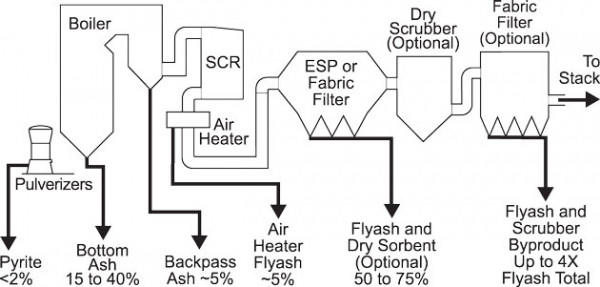
The system is designed to collect ash from multiple points such as boiler hoppers and dust collectors and convey it to a central storage silo using suction created by a vacuum source.
The working process involves:
- Ash is collected from boiler bottom or dust collection units
- A vacuum pump / fan creates negative pressure in the pipeline
- Ash is sucked through pickup points into conveying pipelines
- The air-ash mixture travels to a receiver or separator
- Ash is separated and discharged into a silo via a valve
- Clean air is exhausted through a filter
Key Components of Vacuum Ash Handling System
- Vacuum Pump / Exhauster – Generates negative pressure
- Pickup Points / Suction Nozzles – Collect ash from hoppers
- Pipelines & Bends – Convey ash to storage
- Receiver Vessel / Separator – Separates ash from air
- Cyclone / Bag Filter – Dust-air separation
- Rotary Airlock Valve – Discharges ash while maintaining vacuum
- Ash Silo – Stores ash for disposal or reuse
Design Considerations for Biomass Boilers up to 25 TPH
- Light and fibrous ash (husk/biomass)
- Vacuum level typically -0.3 to -0.6 bar
- Air velocity around 15–22 m/s
- Short to medium conveying distance
- Multiple pickup points in compact layouts
- Smooth pipeline routing to avoid choking
Vacuum vs Pressure Ash Conveying
| Parameter | Vacuum System | Pressure System |
| Pressure | Negative Pressure (Suction) | Positive Pressure (Blowing) |
| Leakage | Minimal, as system operates under vacuum | Possible leakage at joints and seals |
| Pickup Points | Suitable for multiple pickup points | Limited pickup points |
| Conveying Distance | Short to Medium | Medium to Long |
| System Complexity | Moderate | Moderate |
Key Insight
Vacuum conveying systems are preferred for clean, dust-free, and multi-point ash collection, especially in biomass boiler applications. Pressure systems are generally used where longer conveying distances are required.
Applications
- Rice husk fired boilers
- Biomass boilers up to 25 TPH
- Agro-based industries
- Food processing units
- Small industrial boilers
Advantages of Vacuum Ash Handling System
- Dust-free operation
- Ideal for light biomass ash
- Handles multiple pickup points efficiently
- Compact system design
- Reduced housekeeping effort
- Improved safety and cleanliness
Challenges & Solutions
- Choking due to fibrous ash → Maintain proper velocity and routing
- Wear in bends → Use wear-resistant materials
- Limited distance → Optimize layout
- Moisture issues → Ensure dry ash handling
Case Study – Husk Fired Boiler (25 TPH)
An agro-based unit using a 25 TPH husk-fired boiler faced dust and manual handling issues. After installing a vacuum ash handling system:
- Dust emissions reduced significantly
- Ash handling became automated
- Housekeeping improved
- Labor dependency reduced
Frequently Asked Questions (FAQs)
Q1. Why is vacuum conveying suitable for biomass ash?
Because biomass ash is light and easily conveyed under suction.
Q2. Can it handle multiple hoppers?
Yes, it is ideal for multi-point collection.
Q3. Is it suitable for large boilers?
Best suited for small to medium boilers up to 25 TPH.
Q4. What is the main benefit?
Clean, dust-free operation.
Q5. Can ash be reused?
Yes, in bricks, cement, and soil applications.
Conclusion
Vacuum ash handling systems offer a clean, efficient, and reliable solution for biomass and husk-fired boilers. Their ability to operate under negative pressure makes them ideal for industries requiring low-maintenance and environmentally friendly ash handling.